

In this Article:
If your LinkedIn posts feel like they’re reaching fewer people than they used to, you’re right. And it’s not (necessarily) a quality problem on your end.
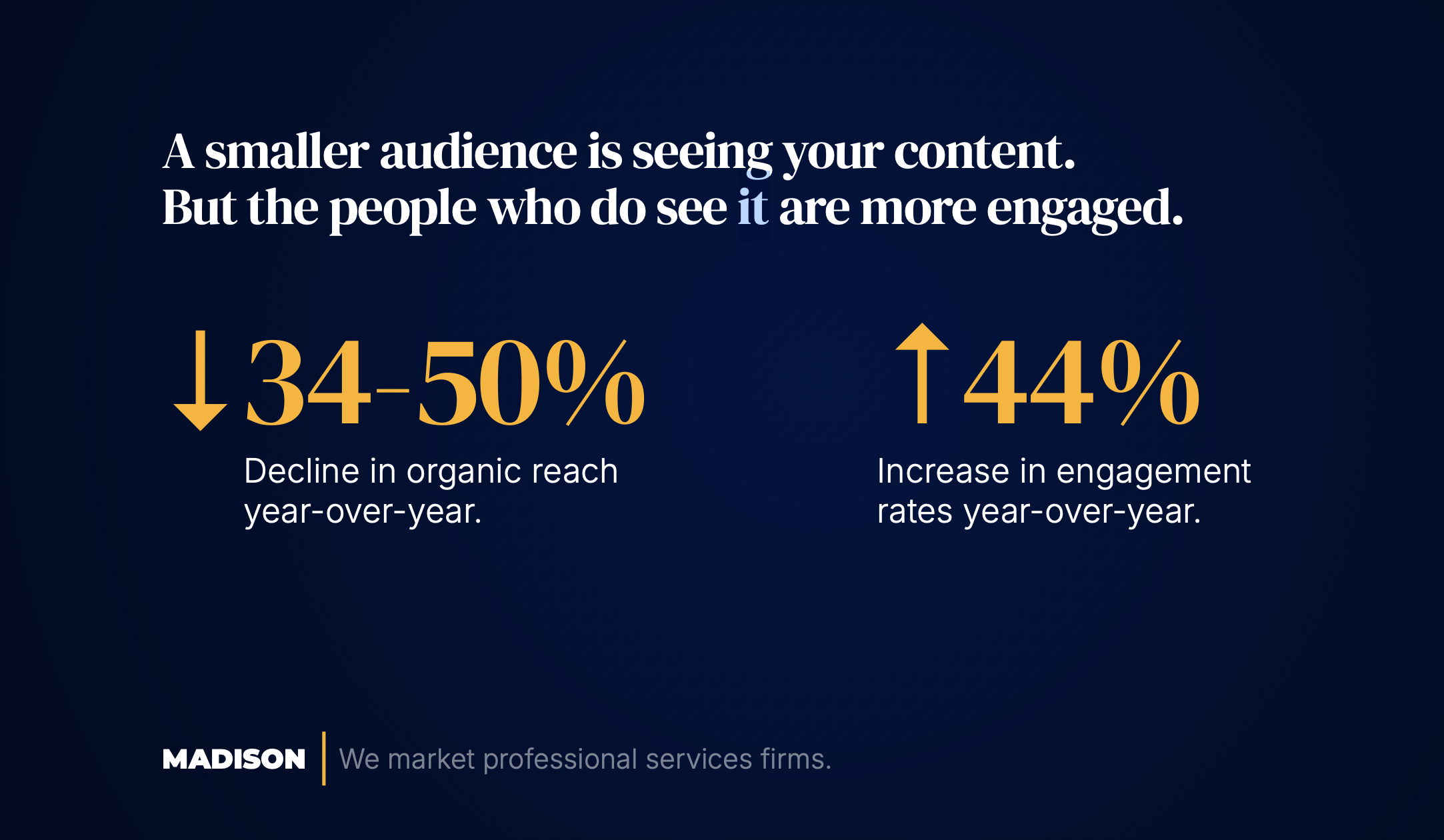
LinkedIn fundamentally rebuilt how it distributes content starting in 2024. The result of those changes was that organic reach for most accounts dropped 34 to 50 percent. Posts that once reached two or three thousand people now reach roughly half that. The change affected nearly everyone, but professional services firms (the law firms, consultancies, accounting practices, and advisory shops that depend on visibility to build trust and generate referrals) have a particular reason to pay attention.
So we reviewed the independent research on what changed, drawing on analyses covering more than 3 million posts, engagement studies of tens of thousands of accounts, LinkedIn’s own engineering disclosures, and executive surveys from Edelman, Bain, the Ehrenberg-Bass Institute, and others.
This article is a summary of what we found and what it means for firms like yours. We believe in being students of the algorithm without being slaves to it. Nothing here is a hack or a shortcut. Most of it amounts to showing up consistently with your best thinking, structured in a way that the platform can recognize and reward.
Why reach matters more than likes
There’s a reason Madison focuses on reach rather than engagement. Reach measures the number of unique people who saw your post. Impressions measure total views, including the same person seeing it twice. Engagement measures direct interactions: likes, comments, saves, shares. All of these matter, but for a professional services firm, reach is the metric most directly connected to business outcomes.
Research from the Ehrenberg-Bass Institute, widely cited by LinkedIn's own B2B Institute, has established that only about 5% of potential B2B buyers are in-market at any given time. The other 95% aren’t ready to buy today, but they’re forming impressions that will shape future decisions.
Separately, a Bain and Google study published in the Harvard Business Review found that 90% of B2B buyers ultimately choose a vendor that was already on their shortlist before the buying process began.
The question isn’t how to convert someone today. It’s how to make sure you’re the name they think of when they’re ready. That’s what reach does. It builds familiarity at scale with the overwhelming majority who aren’t buying yet but will be eventually.
The Edelman-LinkedIn B2B Thought Leadership Impact Report, a recurring annual study surveying thousands of executives, has consistently found that high-quality thought leadership directly influences buying decisions. In the 2024 edition, 73% of decision-makers said an organization’s thought leadership is a more trustworthy basis for assessing its capabilities than its traditional marketing materials, and 90% said they’d be more receptive to outreach from a company that consistently produces it.

The people who consume this content often aren’t the ones who sign the contract. They’re the ones who tell the person who signs the contract which three firms to talk to.
LinkedIn's research with Bain has called them “hidden buyers”: people in procurement, legal, compliance, and finance who hold nearly half the decision-making power in complex B2B purchases but never show up in your marketing analytics.
This is the pattern we see most often. When a prospect puts time on the calendar, and you ask what prompted them to reach out, the most common answer is some version of “I’ve been following you for six months, but didn’t have a reason to reach out until now.” They usually can't name a specific post. They just remember that you said something useful, and they started to associate your name with someone who could solve their problem.
That’s what thought leadership on LinkedIn does when it’s working. And it requires reach to work.
What LinkedIn actually changed
The core shift is architectural. LinkedIn moved from a social-graph model, where your content was shown to people based on who you know, to an interest-graph model, where your content is shown to people based on what it’s about and who would find it useful.
They built an internal AI system called 360Brew to do this. It reads every post, interprets what it’s about, and matches it to users based on their interests and professional needs, not their connection to you.
The system evaluates whether you have credible expertise on the topic you're writing about, and whether the people in its network would benefit from seeing it. Every practical finding in this article is a consequence of this single shift.
The most important implication is that generalists are getting crushed and niche experts are being rewarded.
If you post about a clearly defined area of expertise with consistency, the new system will distribute your content more broadly than the old one did, often to people well outside your existing network. If you post about everything and nothing in particular, your reach will shrink.
Five things that move the needle
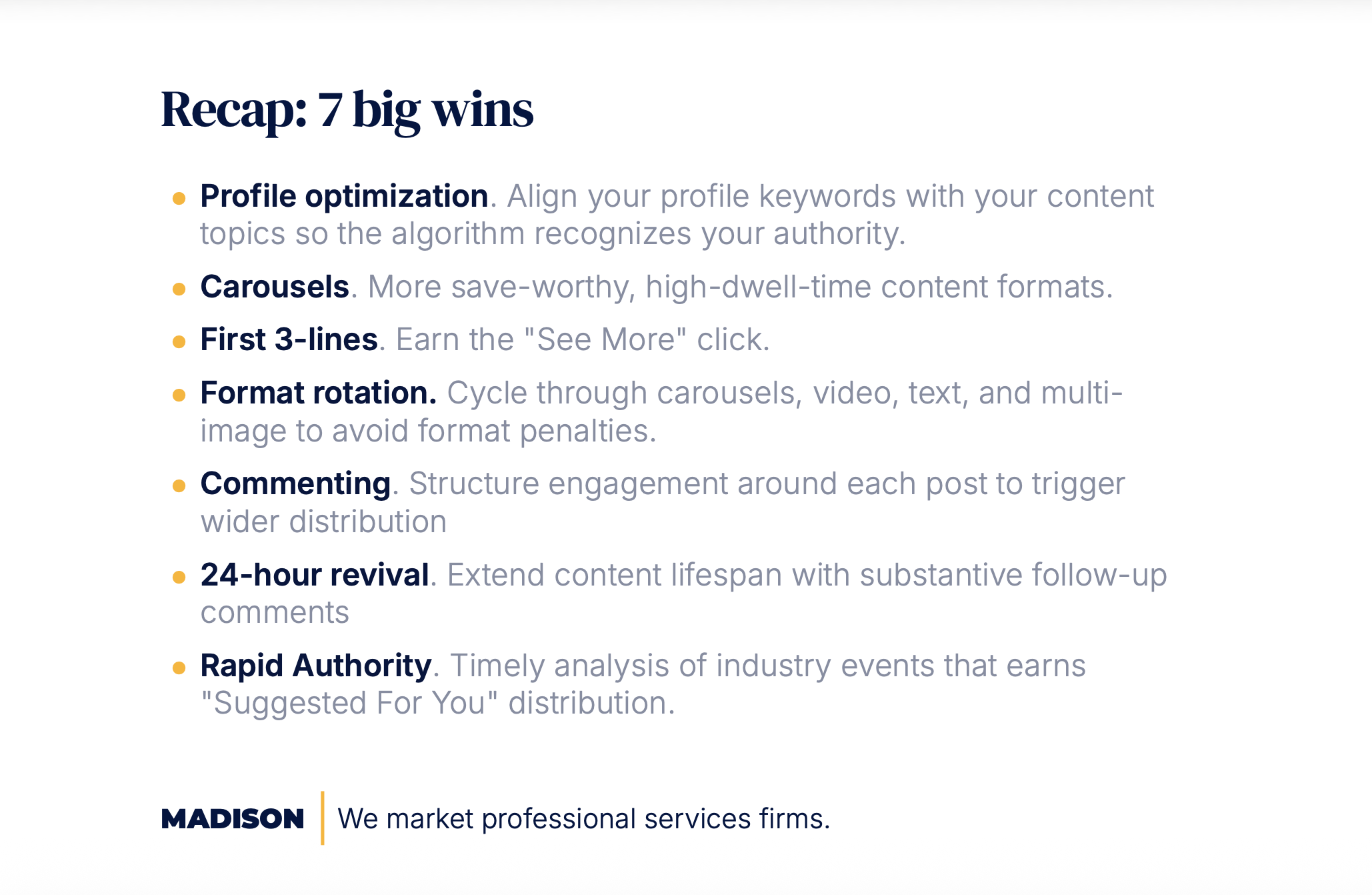
Your profile is now an algorithmic input, not just a resume. The system reads your headline, your About section, your skills, and your endorsements when deciding whether you have authority on the topics you’re posting about.
If your profile says Managing Partner with no keyword-rich context, you’re not giving the algorithm much information to work with. It doesn’t know what you’re an expert in, so it can’t distribute your content to people who’d find it valuable.
This extends to the language in your posts, too. If your core expertise is “portfolio company governance,” use that exact phrase and don’t soften it to “helping startups with oversight.” The algorithm matches the language in your posts to the language in your profile. They need to reinforce each other.
This is probably the single fastest win for most people reading this article: go look at your headline and About section and ask whether it tells LinkedIn what you’re an expert in. And while you’re optimizing your profile, consider adding a custom call-to-action button (available with a Premium account) like “Book an appointment.” Every time you post, readers see your photo, your headline, and that call to action. It means you don't need a hard sell in the post itself.
The first 210 characters of every post are a conversion event. LinkedIn shows roughly 210 characters of your post before the “See More” button. If someone scrolls past without clicking, the algorithm reads that as low interest and restricts distribution.
So the first three lines have to do all the work. They need to communicate the core thesis of the post, not tease it. Don't bury your message 200 words down behind an anecdote. Tell the reader what they’re going to get if they keep reading.
This doesn't mean writing clickbait. You can accomplish it simply by making the first sentence a clear statement of what the post is about.
Longer posts win, but only if they’re worth reading. The algorithm's primary quality signal is dwell time: how long someone pauses on your post in their feed and how long they spend reading it after clicking in. So a save carries significantly more weight than a like in terms of how far the algorithm distributes your content (this is directional and widely reported in practitioner research, notably by Richard van der Blom, though LinkedIn hasn't published exact multipliers).
The first 60 minutes after publishing also matter. Posts that generate no engagement early tend to stay dead.
The formats that perform best on these metrics are ones that give readers a concrete object to spend time with. PDF carousels (12 slides, vertical format, where each swipe counts as a micro-interaction) consistently outperform text-only posts. Checklists, decision trees, and due-diligence frameworks generate saves because people bookmark them for later use. Teardowns and case studies, where you take a public artifact like a regulatory filing, a court ruling, or a deal structure and analyze it, hold attention because readers are evaluating something specific. Substantive analysis of timely events, what LinkedIn classifies as “nuanced text,” also drives dwell time.
People don't skip long posts. They skip boring ones. As long as what you’re saying is specific and useful, length works in your favor because it picks off two levers at once: dwell time and save-ability.
And remember that roughly 75% of LinkedIn traffic is mobile. Short paragraphs, large type, and clean formatting matter for everything you publish, not just video.
Your comments help to shape how the algorithm sees all your future posts. Commenting now shapes the algorithm’s model of your expertise, which affects how all your future posts are distributed. There are two mechanisms at work.
First, replying to comments on your own posts boosts engagement by roughly 30%, according to a Buffer analysis of 72,000 posts across nearly 25,000 accounts.
Second, and this is the bigger deal, when you comment on other people’s posts in your area of expertise, LinkedIn updates its model of what you’re an expert in. It’s building what’s called your “Interest Graph,” and that influences how your own content gets distributed over time.
A good comment does three things: it identifies something specific about the post worth engaging with, it expands on the idea with your own perspective, and it asks a question that advances the conversation. It takes 30 seconds and signals depth to the algorithm. Comments of ten or more words carry significantly more weight than a quick “great post.”
And don’t “post and ghost.” If you publish and then disappear without engaging with others’ content, you’re leaving reach on the table.
Stay in your lane, but your lane can be wider than you think. LinkedIn builds a topic authority profile for every user based on their posting history. If you drift outside what the system perceives as your expertise, it applies a distribution penalty.
But adjacency is fine as long as you connect the topics through your specific knowledge.
A VC lawyer who also advises on founder governance can write about both, because the posts show how those topics relate through their expertise.
You can even go a concentric circle further—writing about the experience of growing a young firm is adjacent to your professional expertise (if it’s part of your story).
The general principle that holds up across the research is roughly 80 to 85% of your posts should be on-topic, with 15 to 20% reserved for the human, personal, off-topic content that makes you someone people want to follow, not just learn from. There will be a small penalty on those posts, but it’s offset by the trust and relatability they build over time. Just enough humanity, as we like to say.
What to avoid
A few things will actively damage your reach. External links in post bodies have historically caused penalties. That’s because LinkedIn wants users to stay on the platform, and content that routes people elsewhere tends to get less distribution. The data here is shifting and somewhat contradictory. Some recent analyses suggest the penalty has softened, while others report it’s gotten stricter. The safest approach for now is to make your post self-contained, delivering the core insight natively, and treat any link as supplementary rather than essential to the post’s value.
Engagement pods, where you arrange with a group of people to like and comment on each other’s posts regardless of content, are prohibited by LinkedIn and reliably detected. The platform’s pattern-recognition systems identify these arrangements with high accuracy, and penalties persist for weeks with no visibility into when they expire.
The same goes for automation tools that submit comments, schedule likes, or manage engagement on your behalf. Bait phrases like “comment YES” or “tag someone who needs to see this” are engagement bait, and the algorithm penalizes them.
AI-generated content is the most consequential item on this list. LinkedIn has not published exact detection rates or penalty figures, but independent researchers, including van der Blom's study of 1.8 million posts, have reported significant reach penalties for content that reads as AI-generated.
And detection will only improve. So AI as a drafting tool is fine. But the output has to be substantially rewritten by a human. It has to sound like you specifically, not like any professional could have written it.
The silver lining
Under the old algorithm, a LinkedIn post had a 24-to-48-hour lifespan. Under the new system, high-quality content can continue to be distributed for two to three weeks. That changes the economics of content creation: each piece works harder for longer.
You can extend this further by adding a substantive comment on your own post 24 hours after publishing. Not a bump, not “thoughts?”, but an actual new insight or additional data point. There’s evidence this can trigger a second distribution wave.
And the deeper silver lining is this: LinkedIn's changes favor exactly the kind of content professional services leaders are best positioned to create. The platform now rewards genuine expertise on specific topics. Named frameworks, concrete numbers, real examples from practice, specific knowledge that only you have. That's what you do every day for clients.
The new algorithm is built to find people like you and show your work to the people who need it.
---
This article draws on independent research from Richard van der Blom's Algorithm Insights Report (1.8M posts from ~89,000 profiles), Socialinsider's LinkedIn benchmarks (1M posts), Buffer's engagement studies (72,000+ posts and 2M+ posts across separate analyses), LinkedIn's own engineering disclosures, the Edelman-LinkedIn B2B Thought Leadership Impact Report (recurring annual study, most recently surveying executives across seven countries), the Ehrenberg-Bass Institute's research on B2B buying behavior as popularized by LinkedIn's B2B Institute, and a Bain/Google study on B2B buyer behavior published in the Harvard Business Review. Note that LinkedIn's algorithm and the research tracking it evolve continuously; we recommend checking for updated editions of these studies. Full source list available on request.